

Select your language


Full Software 2025
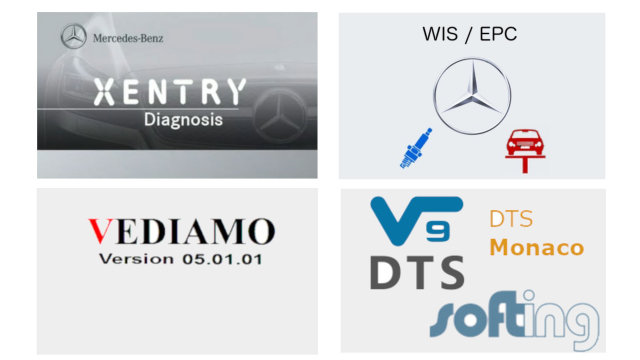
Xentry 09.2025, WIS / EPC, DTS Monaco, Vediamo
Xentry 2025.09
Xentry / DAS 2025.09 Openshell (XDOS) and Passthru (XPT) including activation / licensing and fixes.
Complete diagnosis of all MB cars and vans built since 1989 possible.
The system has developer authorization (developer mode) and therefore offers extended functions (e.g. TV activation while driving, etc.)
DAS Diagnostics is password-free, i.e. special unlocking and coding can be carried out without entering a password (e.g. unlocking the airbag control unit, changing the air conditioning temperature and fan stages, etc.)
DAS Diagnostics can be started as a standalone version without Xentry.
Simulation mode is supported
If you need the complete vehicle range: cars, vans, trucks and bus diagnostics industrial vehicles, construction machinery etc. then Xentry 09.2023 is the last available version.
The SDConnect C4 multiplexer is no longer compatible with Xentry version 09.2025. The latest compatible version is Xentry 12.2024
Functions:
- Test all electrical systems
- Read out and delete error codes, display error codes in plain text
- Reading data from sensors in real time
- Testing all components of the car
- Coding and programming
WIS - Werkstatt Informations System 09.2018
The workshop information system provides you with all the technical descriptions in the form of repair and maintenance instructions, circuit diagrams and much more that are required for the effective completion of maintenance or repair services on Mercedes-Benz and Smart vehicles (WIS).
It also provides data relating to the workshop order in the form of work and standard texts, reference times and work values (ASRA).
WIS and ASRA are two independent applications that can be used both separately and in combination with each other.
EPC - Electronic Parts Catalog 09.2018
With the electronic parts catalog (EPC), you can find all the parts you need for maintenance and repairs in no time at all. You can save your parts volume directly in shopping lists or print it out
With integrated price list November 2018 (currency: Euro)
Full support for data cards
DTS_Monaco v9.02.001
DTS Monaco is the official diagnostic software used by Daimler-Benz development engineers. It serves as a universal engineering test terminal for diagnostic and control functions of vehicle systems. The name “Monaco” is derived from “Modular Analyzer for Vehicle Communication”.
Main features of DTS Monaco:
- Quick test: Enables a quick test of all control units (ECUs) installed in the vehicle and offers the option of selecting specific tests for further analysis.
- Variant coding: Supports the addition or removal of vehicle equipment (SA codes) and enables the adaptation of ECU parameters.
- ID recognition: Reads all modules present in the vehicle with one click and saves their programming numbers.
- Complete variant coding: Allows all ECU coding data to be read out once and rewritten to the vehicle, completely offline.
- Diagnostic functions: Provides advanced functions such as displaying internal and external data modules, activating ECUs, resetting ECUs and modifying the original chassis number.
- Flash programming: Supports programming performed completely offline.
- Error code diagnostics: Reads and analyzes error codes (DTCs) of the modules.
- ECU exchange: Enables data exchange between two identical ECUs by reading and importing data.
- Symbolic tracking: Records and traces files to analyze error logics after repeated viewing.
DTS Monaco offers these comprehensive functions and is an essential tool for the development, testing and preparation of diagnostic sequences in production and service.
Vediamo v05.01.01
Within the Mercedes ecosystem, Vediamo is something like a deep breath inside the workshop software landscape — an internal development and diagnostic tool that reaches far beyond typical service applications. Below is a practical overview of what Vediamo generally enables:
Deep Control Unit Diagnostics
It can communicate with almost any individual control unit, read data, run tests, and observe internal states that standard diagnostic software does not expose. It’s as if you open the “back panel” of the vehicle and watch the electronics think.
Variant Coding & Function Activation
Vediamo allows adjustment of variant coding — enabling or disabling functions that may be physically present in the vehicle but switched off in software. From comfort features to assistance-system parameters, many functions can be accessed when the necessary hardware is in place.
Control Unit Flashing
Software versions can be updated or new firmware can be flashed onto control units. This tool demands respect: it provides access to the deeper system layers and requires care, as flashing directly affects the vehicle’s central electronic pathways.
Developer Modes & Expert Functions
Vediamo provides access to development-level datasets typically locked in standard diagnostic programs. These include advanced test functions, parameter tables, extended diagnostic blocks, and raw data — essentially a small electronics laboratory inside a laptop.
Access to Non-Standard Diagnostic Paths
Many components or functional areas only partially accessible through Xentry can be fully addressed here. For special cases, retrofits, or complex troubleshooting, this is often the decisive tool.
Automated Processes & Scripting
Using sequences, recurring tasks, calibrations, or coding steps can be automated, streamlining workflows and reducing repetitive work.